Monday, June 17, 2013

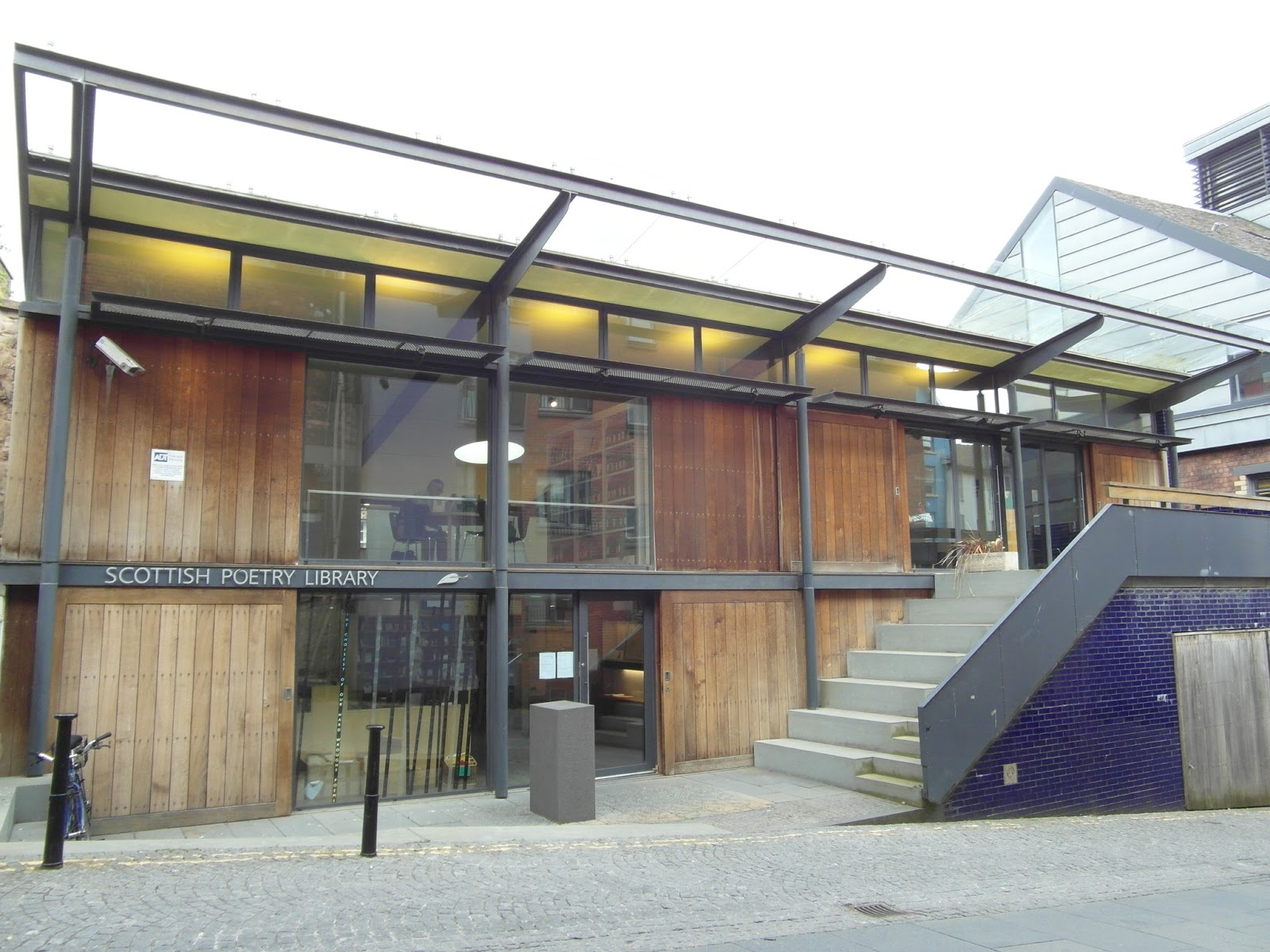
#ELTU1 - The Scottish Poetry Library - 13 June 2013

For me this was a very exciting Library Tweet-Up, not only was it the first in Edinburgh, but I had also volunteered to organise it. So first of all many thanks to the Scottish Poetry Library (@ByLeavesWeLive) for hosting us and Anabel Marsh (@AnabelMarsh), the Library Tweet-Up Godmother for all her advice.


The Poetry Library occupies a stunning modern building designed by  Malcom Fraser just off the Royal Mile in Edinburgh, one of the first lottery funded projects.  

We were met by the librarian, Julie Johnson, who gave us a brief history of the building and pointed out the stairs and the lectern outside the main entrance, to create an outdoor performance space. As someone who thought they knew the Library well, this was new to me and we hadn't even stepped over the door yet! Many other design elements contribute to the building's uniqueness, such as incorporating part of the old City Walls and and a 16th century gable into the fabric. A theme of nature and oak trees and leaves runs throughout the building,  inspired by the quotation from Patrick Geddes which is reproduced at the entrance and gives the twitter account its name.


Membership of the library is free, currently they have about 2000 members and they offer postal loans throughout the UK and Ireland. 

The collections themselves are mainly 20-21st Century reinforcing the ideal of the poetry and the library constituting a living environment. Performance and other activities form a major part of their remit, and many spaces within the librarian are designed to allow flexibility to accommodate these. They are just now running out of space and are commissioning ideas for redevelopment including potentially a recording studio.

They have an extensive periodicals collection,the core of which is Scottish. While printed journal publishing may be declining, pamphlet production is increasing, particularly limited edition, decorative publications. Like most of us they are still struggling with how to collect and epublications. The Library maintains a cuttings collection of reviews etc and every Scottish literary magazine is indexed. They also try to subject index  poets, services led by enquiry service. The small children's section is less used, but most of the work is done in schools or with poets.

The Library has only recently only recently moved into rare and archived materials, primarily with the Edwin Morgan Archive. 


There was also the opportunity to see close-up the latest mystery book sculpure - a delicate birds' nest.


These sculptures  created a storm on twitter and other social media and were the perfect lead in to the next part of the visit,  a discussion with Colin Williams, who has been  Communications manager since last January, previously having been a journalist.

Colin emphasised that the communication reflected the heart of the general strategy, which is bringing people and poems together. Change ideas of how the library works and think of the Library not only and bricks and mortar but also a hub, for example they linked in with Olympics by featuring poems from each competing country. 

He felt that poetry was distinctive, poems being normally quite short, they were unusually mobile and  suited to new media. They have experimented with a number of forms but found that twitter was the most successful, the constraints of 140 characters forcing creativity. 

Some do and don'ts:


Promote poetry and the Scottish Poetry Library
Twitter is all about the voice, which fits in nicely for teh SPL  e.g. they use it for celebrating poets'  anniversaries, followed by few lines of poetry.
People want to be acknowledged and he tries to reply to all  messages 

Don't use them as mini press releases
Have to be careful about individual opinions, e.g. avoid personal politics

They have 14000 twitter followers to varying levels, some never interact, they just like a little poetry in their day. He take victories where they find them. Between  website.  7000 to 49000 per month

For Facebook, they have to register as organisation. This has limitations  and makes metrics more difficult. Most likes are for photos rather than text or events. Though surprisingly Google Analytics indicates more click throughs from Facebook rather than twitter. They have also tried pinterest and flickr, but pushing these may wait until the photo archives are fully organised.

Fitting in with the performance element is their use of Soundcloud for podcasts and poems. They produce 3 podcasts per month which get 300 hits/month.  At different times each day, they mention the latest podcast on twitter, recognising the transitory nature of the twitter stream. A recent innovation was to podcast their annual 20 best Scottish poems which are picked by a guest editor, which was very successful in SoundCloud. Spoken poetry makes it come alive for many people, and it keeps a place for poetry for transitional life events such as weddings and funerals.

All in all everyone found it a fascinating an informative visit and even those of us who had been many times before all learned something.

Hemma

A number of us went along to Hemma, for some of their (now famous) Swedish cider and a hearty meal,  to socialise and discuss the future of the Edinburgh Tweet-Ups. I'm pleased to say everyone felt it was a success and were keen to repeat it. With the first Scottish LibraryCamp coming up in October, we may have time to squeeze one in before then, so I'll sound out out locations and canvass ideas closer to the time.

Finally 'A Big Thank You' to everyone who came along and made the evening the success it was.


#ELTU1 - The Scottish Poetry Library - 13 June 2013SocialTwist Tell-a-Friend

Friday, March 22, 2013

#GLTU8 - The Leningrad Album and Mitchell Library

The most recent of the Glasgow Library Tweetups provided a rare treat - a look at the Leningrad Album and a Behind the Scenes tour of the Mitchell Library (followed of course by the traditional visit to a nearby curry house!)

The Leningrad Album

The history of the Leningrad Album is truly extraordinary.During the darkest days of the the Second World War, while the Siege of Leningrad was at its height, the women of Airdrie and Coatbridge created an album containing messages of support to their counterparts in Leningrad. Through some means it got through the blockade and two years later the women of Leningrad reciprocated, creating an album of thanks producing exquisite drawings of the city and photographs of everyday life in the city. It's difficult to imagine what a feat this was, given the horrendous conditions the women were living under. One story was that an artist could only be supplied with a reference work from the library early in the day - later the staff were too weak with hunger to climb the stairs to fetch it. I visited Leningrad (now St Petersburg) myself some years ago and was very moved by the stories and memorials of the Siege. Unfortunately we were not allowed to take direct photographs of the album today but some pictures along with a much fuller story of the album(s) is on the Scotiana website - I heartily recommend it.


Behind the Scenes


I've recently become quite a regular visitor to the Mitchell, mainly to the archives for family history research, so was delighted to see a bit more of the building. This included trips to the Burns Collection and Jeffrey Library and most exciting of all for us library geeks, visits to the stacks and the basements.


The next photo was taken a couple of months ago, of the old Science and Technology Reading Room, now a display space etc. during the George Wylie 'For the Burds' exhibition.


As always the greatest of thanks to Anabel Marsh, organiser extraordinaire!


#GLTU8 - The Leningrad Album and Mitchell LibrarySocialTwist Tell-a-Friend

Monday, July 12, 2010

Hampton Court Flower Show 2010

A few pictures from my trip to Hampton Court


Long Water


Thought the conceptual gardens were very strong


Shakespeare's Allotment

Amorphophallus Konjac (bought one of these)

Konpira-san

The Garlic Farm (dalek)


This is what gardening in Edinburgh winds feels like.


Grow Your Own area (regimented gardens)

Twelfth Night (I LIKE Livingstone daisies, so there!)


Hampton Court Flower Show 2010SocialTwist Tell-a-Friend

Sunday, September 6, 2009

Friday, December 12, 2008

Friday Book Review: Gardener's nightcap


Gardener's nightcap by Muriel Stuart. London : Persephone Books, 2006.

‘There is an hour just before dark, when the garden resents interference. Its work, no less than the gardener’s, is done.’

As the title suggests this would make perfect bedtime reading for any gardener. It’s a collection of observations planting hints and even the occasional recipe brought together as a sort of commonplace book. What sets it apart from many similar books is the quality of the writing; that the author was a poet is clearly evident. Additionally, unlike modern compilations, generally produced by indifferent researchers, Muriel Stuart’s obvious love of gardening shines through as does some very decided opinions.
Superbly presented by Persephone, with their usual care and attention of design, it is a delight to read.
Friday Book Review: Gardener's nightcapSocialTwist Tell-a-Friend

Friday, December 5, 2008

Friday Book Review: Central Glasgow


Central Glasgow by Peter Stewart. Stroud : Chalford, 1997.
This is much better than the usual `then and now' collections of photographs, with quite informative descriptions of each picture. The author has obviously done some research into the histort of the buildings and businesses pictured.
Friday Book Review: Central GlasgowSocialTwist Tell-a-Friend

Friday, November 28, 2008

Twittering Librarians

Not an insult, but a comment on my recent experiences with Twitter . I admit it has taken me some time to 'get it' and perhaps it is also one of those services which has build a critical mass of like-minded people in order to demonstrate its usefuleness. Anyway, a few weeks ago I took the plunge and yesterday really go my first taste of how useful it can be. A colleague attended the mashed libraries event, which was also of interest to me, and I followed the day's events in real time using the hashtag #mashlib08. It gave much more immediate feeback than waiting for the posts or a report back and additionally put me in contact with people I've never met, but have discovered interests in common.

As an experiment I think this is a success and one to continue.
Twittering LibrariansSocialTwist Tell-a-Friend

Friday, October 24, 2008

Friday Book Review: Our longest days : A people's history of the Second World War


Our longest days : A people's history of the Second World War by Sandra Koa Wing. London : Profile Books, 2008.

I found this to be somewhat disappointing - I'd read Nella Last's War and enjoyed that book, so was hoping for something similar. Mass observation can provide a fascinating sidelight on the difficulties of peoples lives, and how even the 'trivial' changes that war forces on the population can have far-reaching effects and I would like to have seen more of this sort of detail, particularly towards the end where there seemed to be mainly comment on the progress of the war and peace.

One of the problems with this particular book is that there are a fair number of diarists, some only appearing at various times during the period (the diaries are arranged chronologically), so, at least initially, it can difficult to get a sense of whose perspective you are experiencing events through. I'd suggest reading the biographies (which are very brief) before getting into the diaries properly.

As I got further into the book, I did find myself 'connecting' with one or two particular diarists and reading those were much more enjoyable. As is mentioned in the introduction, the diarists tended to come from a particular class and political leanings, so there are still many stories untold.
Friday Book Review: Our longest days : A people's history of the Second World WarSocialTwist Tell-a-Friend

Friday, October 17, 2008

Friday Book Review: Scenes From A Revolution: The Birth of the New Hollywood


Scenes From A Revolution: The Birth of the New Hollywood by Mark Harris. Canongate Books (2008), Hardcover, 496 pages

This is a work which covers a rarely covered period of Hollywood in the standard histories – the mid-Sixties between the hegemony of the old studio system and the rise of the director/auteur. American filmmaking of this decade has been less well catered for than the British industry, with its reflection of ‘Swinging Sixties’.

The author’s approach is to focus in on 5 very different films, the Best Picture nominees of 1967 (In the Heat of the Night, Bonnie & Clyde, Doctor Dolittle, The Graduate, Guess Who’s Coming to Dinner), each of which represent a strand of filmmaking at that time, and hold them up the changes which are going on in society around them. The films themselves may seem tame today, but between them they reflected the impact of the Production Code, the Civil Rights Movement and the rise of counterculture. The argument the author makes that these are radical films which changed (or at least were a catalyst for change) is compelling.

This is a meticulously researched and referenced work, and for any scholarly film historian would be critical reading, however it is also extremely accessible to anyone with a general interest in the history of film (or the Sixties in general). The stories of the five films, one weaving in and out of the other as their gestation occurs over a period of years keeps the reader interested. The principal characters are sharply depicted, almost wickedly so in some cases. Struggling actors and studio moguls alike could almost be stereotypes, but the author provides enough detail and background to create individuals.

It’s the detail that impresses, based on interviews and original documents it makes the work fresh – Ranulph Fiennes attempting to sabotage Dr Dolittle, the trading of scripts and production rights, and perhaps most poignantly these days how filming of In the Heat of the Night was cut short in Tennessee by racism (only one hotel in the town would accept black people).

I’ve read few works on behind-the-scenes Hollywood which attempt to give such a full context for the production, the process is as much the star as any of the actors.
Friday Book Review: Scenes From A Revolution: The Birth of the New HollywoodSocialTwist Tell-a-Friend

Friday, October 10, 2008

Friday Book Review: Geology and landscapes of Scotland


Geology and landscapes of Scotland by Con Gillen. Harpenden : Terra, 2003.


A thoroughly readable account of the geology of Scotland putting it in the context of world processes. Given this is such a complex terrain, he has opted to go fr a regional approach, but has included how the major events which shaped that particular region have also affected elsewhere. For those interested in the history of the science, he also highlights specific areas of importance in the development of geological theory.
The work is extensively illustrated throughout with many clear B&W photographs supplemented by line drawings.
A useful feature is the further resources section, not merely a bibliography, it includes options for further study and a glossary of technical and Gaelic terms.
Friday Book Review: Geology and landscapes of ScotlandSocialTwist Tell-a-Friend

Friday, September 26, 2008

Friday Book Review: Words Words Words


Words Words Words by David Crystal. OUP Oxford (2007), Paperback, 224 pages


This is a much lighter book than many of David Crystal's works. It makes a readable introduction to the subject, actually the chapter summaries seem to suggest that it might be intended for the school/college student. The final chapter includes some exercises (word games?) to test the reader.
Friday Book Review: Words Words WordsSocialTwist Tell-a-Friend

Thursday, September 25, 2008

SCA Meeting - Edinburgh

Not (unfortunately) the Society for Creative Anachronism, but the Strategic Content Alliance, which is only interested in library & information world domination, despite the scary name.

Not the most relevant of days for us but as always I found a couple of intersting sessions.


E-books observatory is always of interest - they are colecting so much data that every presentation/discussion brings up fresh perspective. Today's examples: students spend almost half their time in an ebook looking at the cover. Can you judge an ebook by its cover? They very rarrely use inay of the platform features or interactivity. This may be a chicken and egg scario - they are unfamiliar with these so don't use them, and increased usage may make them more comfortable with using them.
The BBC MemoryShare & CenturyShare sites are interesting concepts - for example we have archived audiocassettes of memories of people working in the printing industry (many libraries must have similar), something like this which puts them on a timeline and in context could bring out the content much more effectively.
SCA Meeting - EdinburghSocialTwist Tell-a-Friend

Friday, September 19, 2008

Friday, September 12, 2008

IGeLU 2008 Madrid


Returned from a successful trip to the IGeLU conference

Some pictures of buildings and gardens on webshots, including the wonderful Bibliometro.
IGeLU 2008 MadridSocialTwist Tell-a-Friend

Friday, August 22, 2008

Friday Book Review: Scottish gardens. Being a representative selection of different types, old and new


Scottish gardens. Being a representative selection of different types, old and new by Sir. Herbert Maxwell. London, 1908

Beautifully illustrated by Mary Wilson, this has fascinating descriptions of many of the best Scottish gardens of that era, interspersed with historical anecdote. The author concentrates mainly on the planting rather than design and layout, with the emphasis on West Coast gardens. Given the publication date of 1908, it is especially fascinating to modern readers as few of these gardens remain in original ownership, or even exist in their original state.
Friday Book Review: Scottish gardens. Being a representative selection of different types, old and newSocialTwist Tell-a-Friend

Sunday, August 17, 2008

JISC/CNI 08: Student Experience Sir David Melville, Chair of the UK Committee of Inquiry into the Student Experience

This is the final round up session

ISC survey in ICT expectations (Sept 07)
Expectations generally based on school experience

Other reading – google generation is wider than we think – adults catch up rapidly once exposed

Follow up questionnaire Supervisors noticed that they were multitasking while filling it in.

“Owned spaces” are very important – can this concept be transferred into innovative physical space design?

Committee looking at FE and schools as well as evidence from futurologists

Age at which w2 becomes ubiquitous getting younger
Needs of future workplace demand these skills

Committee has a website/wiki/discussion forum
www.clex.org.uk

Issues of parental consent with younger children and use of social networks for teaching.

Future problem of assessment of mashedup material


Conclusions
Malcolm Read, Executive Secretary, JISC

Institutional silos are a frustration – libraries not part of the problem.
Information not managed in a strategic way.

Cliff Lynch, Executive Director, CNI

Conversation moved onto a higher level, from mechanics and technical plumbing to contributing to teaching & learning Libraries need to be assertive in carrying out a deeper mission in institutional & research data management
Speed of maturation of repositories & sophistication of digitisation.
Simple finding – overelaborated complexity needs to be tackled as aprt of improving the user experience


What is UG education for? Affects whole principle of teaching; when does technology help in learning how to think? (What always wories me is that information literacy/library skills have been taught here for decades, with it appears no effect - what are we doing wrong?)


JISC/CNI 08: Student Experience Sir David Melville, Chair of the UK Committee of Inquiry into the Student ExperienceSocialTwist Tell-a-Friend

JISC/CNI 08: Learning Objects and Instructional Materials

JORUM New Directions: Peter Burnhill/Jackie Carter, JORUMUK

Reason to have content outside the VLE because of the proprietary nature and variety of platforms

Originally designed to be used within an institutional setting as part of a course, now we have more open learning, how might that affect usage?

2 services: Keep-safe mandate & JORUM R&D

23% HEI, project12% FEI contributors 2200 resources
80% HEI, 60% HEU users, 5000+ users, 9600+ downloads

Showcase

JORUM predates emergence of open access; now being repurposed for ‘open sharing’ and showcase for UK commitment to Open Education Resources.

Future plans to shift out of the realm of education technologists, to make more accessible. Question as to whether we should focus on academics or students?

Developing new licensing regimes

JorumOpen
Jorum EducationUK
JorumPlus


Merlot – project which rather than collect objects, collects pointers to objects (US)

FF - To realise potential must go direct to learner – can they also be contributors?

Measurement of re-use & repurposing of resources.
Looking at getting more community engagement; currently reliant on feedback
JISC/CNI 08: Learning Objects and Instructional MaterialsSocialTwist Tell-a-Friend

Sunday, July 27, 2008

JISC/CNI 08: The Next Steps of Electronic Books

JISC national e-books observatory project - a UK wide laboratory: Lorraine Estelle, Chief Executive, JISC Collections

It was noted that the textbook sector does not engage with library – direct to student via academics

That the project was restricted to only 36 books indicates how nervous publishers were and the level of pricing they were charging

127 subscribers to myiLibrary platform (3 subjects)
80 to Ovid (medical)

90% librarians believed e-textbooks should be free at point of use
>22000 responses to survey from users (123 universities)
50% teachers not happy
65% media students “”
But 60% already using ebooks
3.1% thought about buying the book
35% using library
40% share with friend
62.6% read from screen; 6% print off
Equal numbers visit library/access elsewhere
Women in particular appreciated access to digital library, much more than men
Expect access via catalogue

Preliminary results from data with Student use from January
Finding opposite behaviour to superbook project; here only 5% of time spent searching; 72% going straight to content
Attributing to Superbook only third were catalogued – evidence that cataloguing is a user focussed and worthwhile activity

Taking what we observe students doing and use it to inform construction of the ebook. Are we taking ancient physical structures & navigation into a new world.

Repeat using survey asking them why?

The Gutenberg-e Electronic Book Project: Opportunities and Challenges in Publishing Born-Digital Monographs:
Kate Wittenberg, Director, Electronic Publishing Initiative, Columbia University


Prizes for best new scholarship by American Historical Association.
Condition of additional work to transform from print dissertation to born-digital book
Project Goals
Workshops with authors to enable them
Change in attitudes towards digital publishing within academy
Contain costs of publishing scholarly monographs
Findings
Authors & publishers became close active collaborators rather than ‘lone toilers’
Both sides became more interested in possibilities and more creative
Attitudes towards digital publications evolved – eg concerns that digital monographs hadn’t gone through same rigorous review process as print.
Time & costs exceeded expectations (possibly because the project had blank slates –perhaps for commercialisation need controls similar to print)

Must the scholarly narrative be presented in a linear form?
How does one present an ‘authorial voice’?
Are image & archives supplementary or the organising structure?
Can new ‘textbooks’ be created by integrating ebooks and teaching tools

Tension between author’s creativity and a very traditional environment e.g. some journals would refuse to review born digital so had to create ‘bound galleys’ Seen some changes particularly in the last couple of years.

Potential can create high costs – need to agree on what can be expected
Enhanced collaboration can increase costs and times; the levels of support decreased with later groups.
Need for continuing innovation; and changes from authors, bulishers and universities attitudes.

www.gutenberg-e.org
www.humanitiesebook.org


Companion websites
Publishers lack of integration of ebook/website something which needs further investigation.


Effects of hardware e.g Kindle; current project looked at content

Would catalogue work as a discovery platform for 1000s ebooks - it does for print
JISC/CNI 08: The Next Steps of Electronic BooksSocialTwist Tell-a-Friend

JISC/CNI 08: Web 2.0/Student 2.0: The Key Challenges for HE over the next 5 years - Conor Galvin, UCD Dublin

7-8 overall challenges

Identity in the modern world
Multiple, fluid, contingent
Relative importance of associations, and in context

Deep relationship with technology, highly visual, we’re not ready – native users from the unremarkable to the unrecognisable. Breadth but not necessarily depth of usage cf university tools

To engage with this generation He has to be:

Personalised
Meaningful
Multi-componential – across discipline boundaries
Profiled and portable

How does your institution rate in these terms? Most in the room rates themselves less than 4/12 http://Demos.co.uk Their Space report ECAR study from 2007 Horizon report highlights 6 key challenges > Techlearning blog 15 minute introduction Educause came back with a number of quick projects which could make a difference

Practical examples of open learning
OU
MIT/Stanford
SURF Foundation


How do we reframe the higher education learning experience?

What is education for?
Divergence between generations
Education for practical working citizenship
Creative living – quote from Modern social imaginaries/Charles Taylor
We need a new social imaginary for higher education
Rethink how we teach and support and assessment

Smart usage:
Happening at the lower level of learning e.g. project based learning
Examples of innovative projects
Alice @ CM reducing dropout rates by 100%
UCD library in 2L

Learning Design
Making/remaking the individuals environment
Learning is networked and should be a hopeful experience – we should be prepared to learn as well as teach

Information Services is at the nexus
Can
provide the architecture
provide the foresight

HE cores
Values
Capabilities
Opportunities
JISC/CNI 08: Web 2.0/Student 2.0: The Key Challenges for HE over the next 5 years - Conor Galvin, UCD DublinSocialTwist Tell-a-Friend

JISC/CNI 08: Infrastructure to Support Research and Learning

Cyberinfrastructure and Cyberlearning: Cliff Lynch, Executive Director, Coalition for Networked Information (CNI)

This looks at issues from a US perspective
NSF Office of Cyberinfrastructure/Office of Educational Resources
How can we leverage these two funding streams?

Technology enabled education reaches beyond traditional models, not only for adult education, but also to supplement e.g schools. Museums have moved into this in an aggressive way. Platform for advancing relationships between professional & amateur science. The massive data resources can be used for teaching.

Spent far too long creating information objects/courses which cannot be sustained, either because of platform obsolescence or funding. Need platforms which last for a decade at least. Data deluge also applies to learning systems, about how the students are interacting with them; new tools are developed in some areas. Privacy issue is a caution on this e.g cannot build recommenders without user history; but learning systems can be open to abuse. How much privacy should users have? Would this impact on projects such as the digital lives project?

Report recommendations re openness – default should be skewed towards openness
4-5 weeks due
JISC/CNI 08: Infrastructure to Support Research and LearningSocialTwist Tell-a-Friend